The Real Measure of Progress in Payments: Client Outcomes
Progress should be visible in the way clients work. Can they bring new relationships on board faster? Can they put funds to work sooner? Can they...
3 min read
By J. Patrick Law, President and CEO, CheckAlt
Progress should be visible in the way clients work. Can they bring new relationships on board faster? Can they put funds to work sooner? Can they reduce manual effort and create more capacity to grow? Those are the outcomes that matter.
Over the past year, CheckAlt has strengthened its business by sharpening its focus, deepening important relationships, and investing in the people, technology, and operating capacity needed to support continued growth. We have helped clients onboard new relationships faster, reduce payment acceptance costs, and accelerate access to funds.
That progress reflects a deliberate choice about where CheckAlt can make the greatest difference. We are focused on helping financial institutions, fintechs, and businesses manage the full mix of payments they receive while reducing the operational work behind them.
We have continued to improve the way clients implement and use CheckAlt solutions. Once a financial institution is live with CheckAlt, subsequent lockbox clients can onboard 75% faster than the industry average, often within a week. That gives institutions a faster path to serving new commercial relationships and generating value from them.
Clients are also improving the economics of payment acceptance. By combining traditional lockbox processing with electronic payment options, organizations can convert an average of 20% to 30% of check volume to electronic payments, reduce payment acceptance costs by up to 60%, and accelerate funding by four to five days per payment cycle.
These results reinforce a belief I have carried throughout my career: modernization is useful only when it solves a real business problem. For our clients, that means putting funds to work sooner, lowering costs, simplifying reconciliation, and removing friction from the way payments are received and processed.
Our progress is also visible in the relationships we have built and expanded. Over the past 12 months, we signed 45% more new clients than in the prior 12 months, with growth across multiple industries. We are seeing the same momentum within existing relationships. One clear example is a healthcare fintech partnership that surpassed 1,000 lockboxes in less than two years by combining its technology with our lockbox infrastructure and APIs. Those results reflect the trust clients and partners place in us to manage an important part of their payment operations.
We have grown by understanding the unique needs of clients across the markets and industries we serve. Financial institutions want to strengthen commercial relationships without adding operational burden. Fintechs need processing expertise and infrastructure that can scale behind their client experience. Businesses want fewer manual steps and better visibility across the payment channels they already use. Our job is to bring the right technology, processing expertise, and operational support to each.
Financial institutions are placing greater emphasis on receivables and payment technology. Our 2026 research with Datos Insights found that 75% of surveyed financial institutions are evaluating, or plan to evaluate, receivables and payment technology within the next 18 months. The study also found that 88% believe stronger receivables and payment capabilities could support commercial banking revenue growth. That is consistent with what clients tell us: receivables can help banks and credit unions attract, retain, and grow commercial relationships.
CheckAlt's recognition on the Datos Insights Fintech 50 for the second consecutive year further reflects our continued focus on integrated receivables and payment processing.
Helping businesses add more digital payment options is part of that opportunity. Many still rely on checks, so financial institutions need to support both without adding disconnected processes or more manual work. That need continues to guide where CheckAlt invests and how we work with clients.
There is no shortage of talk about AI and its possibilities. At CheckAlt, we have been deliberate about putting AI to work. We start with a real problem and build from there.
A little over a year ago, we built Genie as an AI assistant for clients, giving them faster access to reliable answers. Since then, we have expanded Genie into our own internal AI platform, available to every CheckAlt employee. Today, our teams use it to find information faster, reduce repetitive work, solve client problems, and develop new ideas.
We have also built agentic AI into specific workflows, where it can help complete defined, multistep work rather than simply answer questions. That moves us from answers to action and gives our people more capacity to serve clients.
We will not trade trust for speed. Our technology, operations, risk, and compliance teams work together to establish the permissions, controls, and human review each workflow requires. AI has to make our people more effective and our service to clients stronger. That is how we will measure its value.
None of this progress belongs to one person or one team. It reflects employees who solve difficult problems, clients and partners who challenge us to improve, and leaders who are building greater capacity and discipline across the company.
CheckAlt now has a clearer focus, stronger relationships, broader capabilities, and a better foundation for growth. Those gains matter because organizations increasingly need partners that can take on more of the complexity around payments without adding complexity to their own operations.
The work of the past year has prepared CheckAlt to support more clients and more complex payment needs without losing the discipline and service that earned their trust. As we grow, we will continue to measure progress the same way we do today: by whether our clients can move faster, operate more efficiently, and create more capacity to grow.
Progress should be visible in the way clients work. Can they bring new relationships on board faster? Can they put funds to work sooner? Can they...
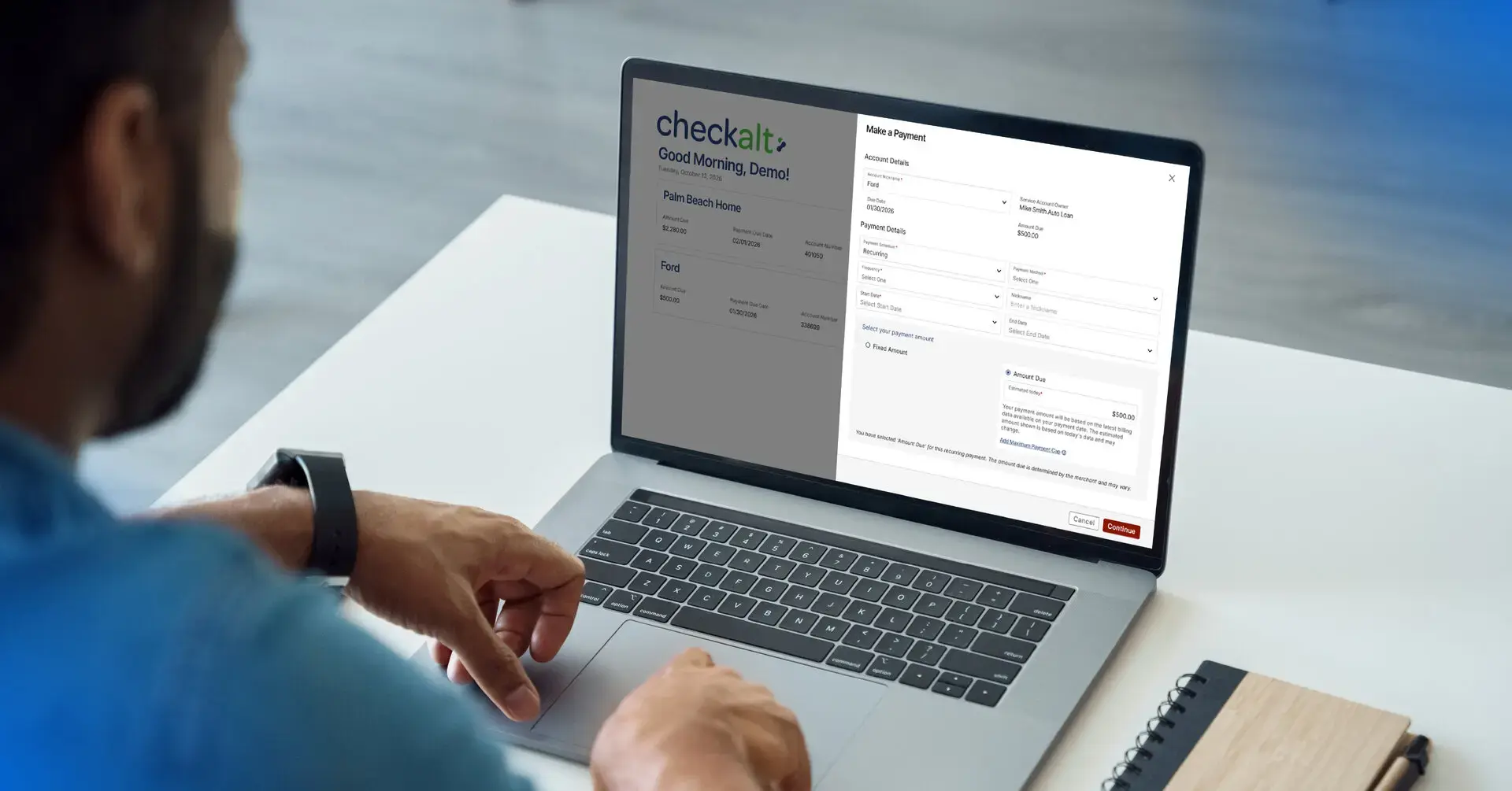
Online payments are a standard part of how consumers and businesses pay bills, invoices, loans, and other obligations. Whether paying a utility bill,...

AI has quickly become a priority for many financial institutions. The pressure to figure out where AI fits is real, but that can lead teams to start...