4 min read

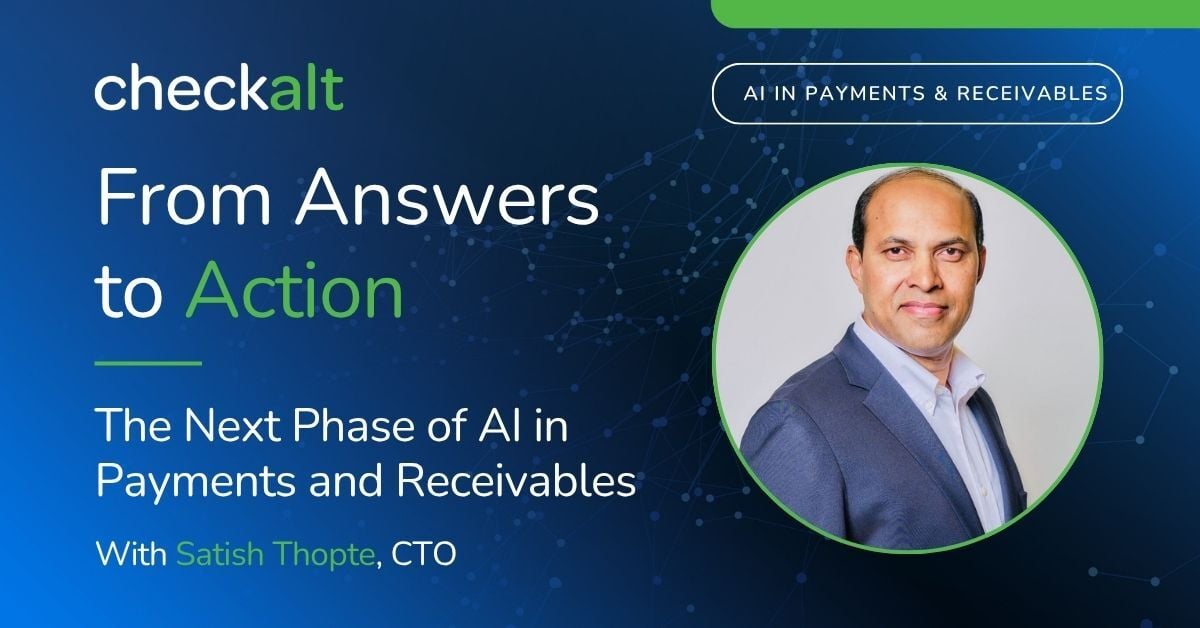
From Answers to Action: The Next Phase of AI in Payments and Receivables

From Answers to Action: The Next Phase of AI in Payments and Receivables
7:12
Why the shift from generative AI to agentic AI matters for payments and receivables workflows.

Watch the Video: AI In Payments & Receivables: From Answering Questions to Moving Work Forward

Receivables workflows are full of small but persistent points of friction. They show up in routine onboarding steps, repetitive administrative tasks, exception handling, and the need to re-enter or verify information across systems. None of those activities is especially complex, but together they create friction, add handoffs, and make routine work harder than it needs to be.

Those recurring points of friction are pushing the AI conversation in payments and receivables beyond better answers and toward a more practical question: how can AI help move work forward? What started with generative AI and better access to information is now expanding into agentic AI and a broader focus on reducing friction inside the workflow itself.

In a recent conversation with CheckAlt CTO Satish Thopte, we discussed the shift from AI that answers questions to AI that helps move work forward—and what that could mean for payments and receivables workflows.

Why the AI Conversation in Payments Is Changing 

The first wave of practical AI adoption focused heavily on information access. Teams wanted faster ways to surface answers, search knowledge, and improve support without adding more manual effort. That was a logical place to start, especially in environments where users often need quick guidance to move through questions, issues, or requests. 

For payments and receivables teams, however, better answers are only part of the story. The larger opportunity is improving how the work itself gets done. The value of AI increasingly sits not only in what it can tell a user, but in how it can help reduce steps, support the next move, and keep workflows moving. In an environment filled with repeated tasks, structured processes, manual handoffs, and exceptions, that shift becomes much more meaningful. 

What Agentic AI Means in Practical Terms 

In payments and receivables, agentic AI is AI that can understand context, identify or recommend next steps, and help move workflows forward across repetitive, rules-based, and exception-heavy processes. That means moving beyond AI that simply responds to a request and toward AI that can better support the next step in the workflow. 

That distinction matters because payments and receivables workflows often involve more than a single interaction. They may require configuration, setup, validation, access changes, exception handling, or administrative follow-through. When AI can help support those next steps, the experience becomes more useful and the workflow becomes easier to complete. 

In practical terms, that can mean helping a user move from the question to the action more efficiently instead of stopping at the answer alone. It can reduce manual steps, shorten routine processes, and make common workflows easier to navigate. 

Why Payments and Receivables Are a Strong Fit

Payments and receivables are a strong fit for agentic AI because the work is often structured, repeatable, and operationally dependent. These environments frequently involve multiple systems, manual handoffs, setup and onboarding tasks, and exception management that can slow work down when too much human effort is required just to keep things moving. 

That is where practical AI can create meaningful value. When AI can help guide the next step, support setup and configuration, reduce repetitive effort, or streamline common administrative tasks, the impact is not limited to user experience. It also improves the operational experience behind the scenes. 

For financial institutions, fintechs, and businesses, the operational benefits connect directly to broader priorities like modernization, operational resilience, and workflow efficiency across payments and receivables. The value of agentic AI is not in vague future-state claims. It is in helping make common processes faster, easier to manage, and less dependent on manual effort. 

From Answers to Action

A useful way to think about agentic AI is as a move from assistance to action. Generative AI made it easier to surface answers, find guidance, and reduce friction in support environments. That remains valuable. In payments and receivables, though, the next opportunity is not just answering the question. It is helping users take the next step once they have the answer.

“In its simplest form, agentic AI is not just about answering questions. It is about taking action, walking through the multi-steps, and helping get the work done.”

— Satish Thopte, Chief Technology Officer, CheckAlt

In practice, that can mean helping users complete a task more efficiently, reducing the number of manual steps required, pulling forward known information, or supporting the next action in a setup or administrative process. The focus is moving beyond the answer and into the workflow itself.

For payments and receivables teams, this shift from answers to action makes AI more practically relevant in day-to-day operations. The opportunity is not just to improve access to information. It is to help teams keep work moving through routine workflows.

How Agentic AI Is Starting to Show Up in Real Workflows

Some of the clearest early examples of agentic AI are showing up in the routine tasks that tend to create the most friction—changing permissions, setting up new users or accounts, mirroring configurations, onboarding new merchants, and moving through multi-step administrative workflows that are manual and time-consuming.

In our latest video conversation, Satish Thopte points to user access management and onboarding as early examples of where agentic AI starts to become practical.

“With agentic AI, routine workflows like merchant onboarding or mirroring user access become more of a conversation than a repetitive activity. Instead of working across multiple screens and manually entering or re-entering information each time, you simply tell the AI agent what you need done, and it can help do the work for you.”

— Satish Thopte, Chief Technology Officer, CheckAlt

In both cases, the practical benefit comes from reducing the number of manual steps involved in completing routine operational tasks. Rather than starting the process from scratch each time, AI can pull forward known information, support configuration steps, and reduce the effort required to complete the task.

The impact of agentic AI becomes much more tangible when it improves the everyday workflows that create friction. The result is greater efficiency, fewer manual steps, and less operational drag.

What Comes Next for AI in Payments and Receivables

The AI conversation in payments and receivables is evolving quickly. What started with generative AI and better access to information is now expanding into more intelligent workflow support and more practical operational use cases.

“We do not want to solve something just because the model can do it. We want to solve real problems where AI can reduce friction and improve the workflow.”

— Satish Thopte, Chief Technology Officer, CheckAlt

For agentic AI to matter, it has to show up in real workflows and deliver practical operational value—not just sound innovative. The point is not to apply AI for its own sake. It is to apply it where it can reduce friction, simplify routine workflows, and solve real operational problems.

From Answers to Action: Explore the Full Conversation With Satish Thopte

For more on the shift from generative AI to agentic AI, watch the latest video with Satish Thopte. It expands on the ideas in this article and highlights how intelligent workflows are starting to take shape across payments and receivables.


From Answers to Action: The Next Phase of AI in Payments and Receivables

From Answers to Action: The Next Phase of AI in Payments and Receivables

Why the shift from generative AI to agentic AI matters for payments and receivablesworkflows. Watch the Video: AI In Payments & Receivables: From...

Read More
The Missing Piece of Real-Time Payment Processing: Integrated Receivables

The Missing Piece of Real-Time Payment Processing: Integrated Receivables

Editor’s Note: This article has been updated from its original publication in April 2021. Faster payment expectations are changing how organizations...

Read More
Lockbox Explained: How It Works and Why It Still Matters

Lockbox Explained: How It Works and Why It Still Matters

While the payments industry has continued shifting toward digital payments, many organizations still rely on checks for inbound payments. That’s why...

Read More